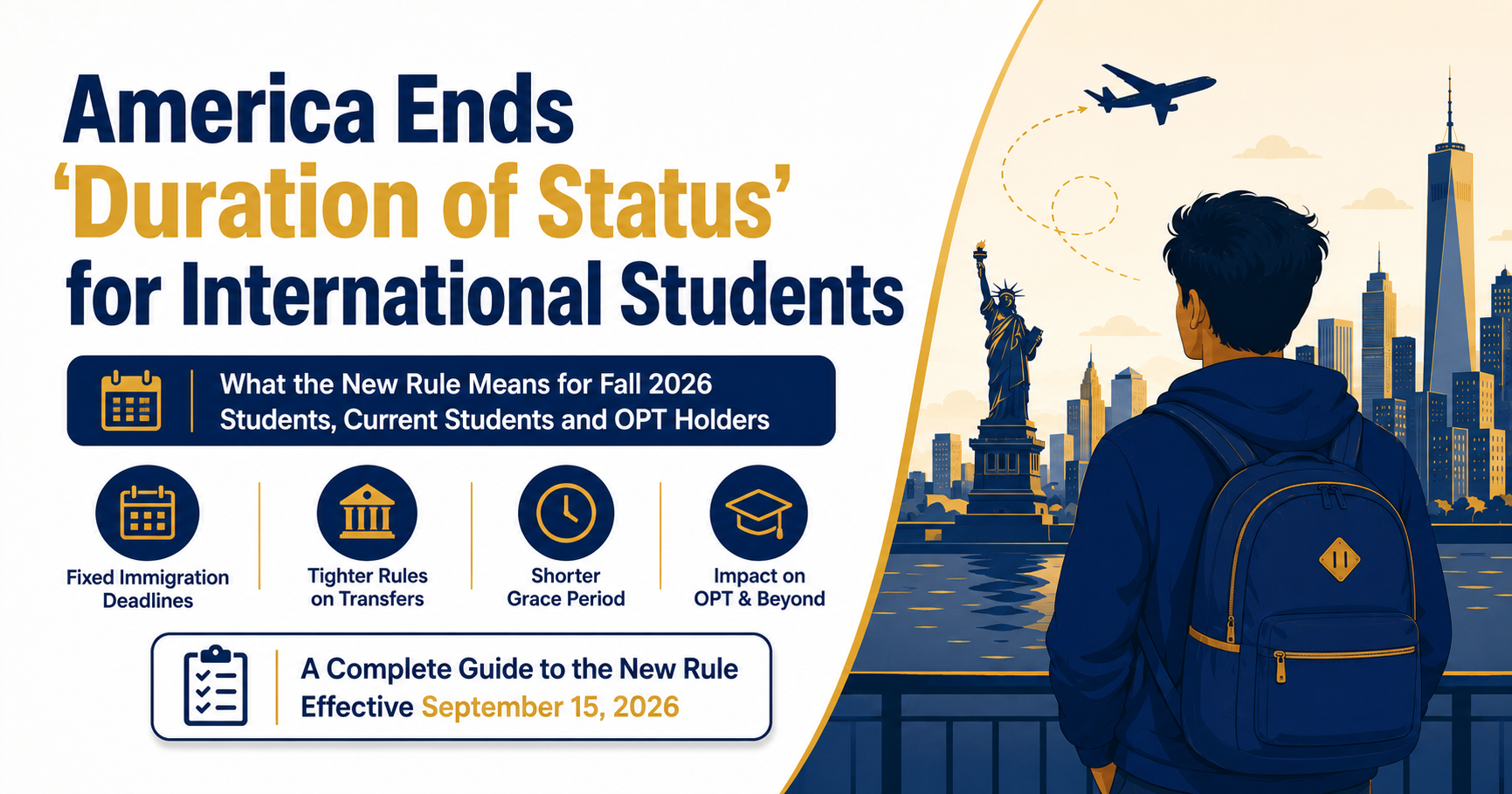
The US has ended the Duration of Status rule for F-1 students starting September 15, 2026. Learn what the new regulations mean for current and future international students, and how to plan with confidence.
When news like this breaks, I know what happens in many Indian homes.
A student who has spent months preparing for the US suddenly starts worrying whether their dream is slipping away. Parents who have saved for years begin wondering if the rules have changed halfway through the journey. Phones start buzzing with messages, social media fills with half-truths, and before long, anxiety spreads faster than facts.
Over the years, I've learned that moments like these call for calm, not panic.
Yes, the US has announced an important change to its student immigration rules. It will affect how international students maintain their legal stay in the country. But it does not mean the US is closing its doors to international students, and it certainly does not mean students should abandon their plans.
What it does mean is that planning, paperwork, and understanding the rules have become even more important.
Let's look at what has actually changed.
What Was "Duration of Status"?
For many years, students studying in the United States under an F-1 visa were admitted under something called duration of status, often written simply as "D/S."
The idea was fairly straightforward.
As long as a student remained properly enrolled, made normal academic progress, followed the conditions of their F-1 status, and maintained valid documents through their university, they could generally continue studying without having a fixed date by which they had to leave the country.
Instead of receiving an admission that expired after a set number of years, their ability to stay was tied to their studies.
For many students, this system offered flexibility.
A bachelor's degree that took a little longer because of research, a master's programme that required extra time, or a PhD with changing research timelines could usually continue without needing a separate extension of stay every few years.
That flexibility is what many students have become familiar with over the years.
What Has Changed?
On 17 July 2026, the US Department of Homeland Security published a final rule that replaces the long-standing duration of status system for F-1 students and J-1 exchange visitors.
The new rule is scheduled to take effect on 15 September 2026.
Until that date, the current D/S system remains in place.
After the new rule takes effect, students will generally be admitted for a fixed period instead of an open-ended period linked to their studies.
In most cases, that admission period will be tied to the programme end date shown on the student's Form I-20, with a maximum admission period of four years at a time.
For many students completing a standard bachelor's or master's programme within that period, the practical day-to-day experience may not feel very different.
The bigger change is for students whose academic journey extends beyond those four years.
Why the Four-Year Cap Matters
When families first hear "four-year cap," they often assume students must leave the United States after exactly four years.
That isn't quite how the rule works.
If a student legitimately needs additional time to complete their education beyond the authorised admission period, they may apply for an extension of stay with US Citizenship and Immigration Services by filing Form I-539.
In other words, continuing beyond four years is still possible.
However, it is no longer automatic.
Students will need to apply, provide supporting documentation, and receive approval to continue their stay.
That is an important difference.
Under the previous system, maintaining your academic status at the university was usually the key requirement.
Under the new system, immigration paperwork becomes a much more active part of a student's long-term planning.
The Grace Period Is Becoming Shorter
Another change that deserves attention is what happens after students complete their programme.
Previously, many F-1 students had a 60-day grace period after finishing their studies.
That time allowed students to prepare for departure, transfer to another programme if eligible, or make other lawful arrangements.
Under the new rule, that grace period will generally become 30 days.
For some students, this may not make a significant difference because they already have clear plans.
For others, particularly those who leave important decisions until the last minute, those missing 30 days could matter a great deal.
I've always encouraged students not to think about immigration paperwork only when graduation arrives.
This change reinforces that advice.
The earlier you understand your options, the more choices you'll usually have.
This Is About Planning, Not Panic
Whenever immigration rules change, rumours spread quickly.
Some people immediately assume studying in the US has become impossible.
Others believe every current student must suddenly leave the country.
Neither of those reactions reflects what the rule actually says.
Yes, the rules are changing.
Yes, students will need to pay closer attention to timelines and documentation.
But international students remain an important part of American universities, classrooms, research, and innovation.
The opportunity to study in the United States is still there.
The process is simply becoming more structured.
As with many immigration changes around the world, success will increasingly depend on staying informed and planning ahead rather than reacting at the last minute.
What If You're Starting in Fall 2026?
This is probably the question I'm hearing the most.
If you're planning to begin your studies after the new rule takes effect on 15 September 2026, you should expect these updated immigration procedures to apply to you.
That doesn't mean your admission is at risk.
It simply means you'll need to pay more attention to your immigration timeline throughout your studies.
For many undergraduate and master's students whose programmes fit comfortably within the authorised admission period, the experience may look very similar to what students have gone through in recent years.
The difference is that your immigration status will now have a more clearly defined timeline, and if your studies need to continue beyond that authorised period, you'll have to apply for an extension instead of relying on the old duration of status framework.
Think of it as adding another important date to your academic calendar.
What About Students Already in the US?
This is where I want many families to take a deep breath.
If you're already studying in the United States before 15 September 2026, the rule includes transition protections.
You are not suddenly out of status because the regulation has changed.
In general, students already in the country can continue according to the timeline associated with their current Form I-20.
The same applies to many students who are already on OPT or STEM OPT before the rule takes effect. Their existing employment authorisation generally continues under the transition provisions already in place.
That's an important point because I've seen unnecessary panic online from students who believe they have to leave immediately.
That simply isn't what the rule says.
Always rely on official guidance from your university's international student office and USCIS rather than social media posts that leave out important details.
Longer Academic Journeys Will Need More Planning
Not every student's education follows a straight line.
Research programmes, doctoral degrees, and certain specialised fields often take longer than expected.
Under the previous system, there was greater flexibility as long as students maintained valid F-1 status and continued making normal academic progress.
Now, students whose studies extend beyond their authorised stay will need to think about immigration planning much earlier.
Graduate students may also find that changing degree objectives or transferring partway through a programme involves tighter restrictions than before.
Similarly, students hoping to pursue a second degree at the same or a lower academic level may face new limitations. In most situations, continuing in F-1 status will generally require progressing to a higher academic level rather than repeating one already completed.
These aren't reasons to avoid ambitious academic goals.
They're simply reasons to plan them more carefully.
A Few Other Changes Worth Knowing
There are a couple of additional updates that students should keep in mind.
Students beginning with English-language training alone should know that standalone English study is now generally limited to a total of 24 months.
Another important change affects transfers.
Undergraduate students will generally need to complete their first academic year before transferring to another university unless an exception is approved.
For families, this means choosing the right university from the beginning becomes even more important.
Changing your mind after arriving may not be as straightforward as it once was.
These changes don't remove opportunities.
They simply reduce the amount of flexibility students previously enjoyed under older student visa rules.
Could the Rule Still Change?
Immigration policy is rarely static.
It's possible that this regulation could face legal challenges in the months ahead.
As I write this, however, no court has blocked the rule.
That means students should make their plans based on the assumption that it will take effect as scheduled on 15 September 2026.
If anything changes in the future, universities and government agencies will issue updated guidance.
Until then, planning based on the current law is the most sensible approach.
My Advice to Every Student and Parent
Whenever immigration policies change, it's easy to focus only on the headlines.
I encourage you to focus instead on what you can control.
Choose your university carefully.
Keep your documents organised.
Stay in regular contact with your university's international student office.
Don't ignore emails about immigration deadlines.
And if your academic plans change, seek professional guidance early rather than waiting until the last moment.
I've always believed that studying abroad is about much more than getting an admission letter.
It's about successfully completing the entire journey.
The students who usually have the smoothest experience aren't necessarily the smartest.
They're the ones who stay informed, ask questions, and prepare well in advance.
This update to the duration of status policy doesn't close the door on studying in the United States.
It simply means that immigration compliance becomes a more active part of your education.
If you understand the rules and plan accordingly, there's every reason to remain confident about your goals.
The United States continues to offer world-class universities, outstanding research opportunities, and excellent career pathways for international students.
That hasn't changed.
What has changed is the importance of staying organised from the day you arrive until the day you graduate.
If you're unsure how these new rules fit into your personal study plan, don't rely on guesswork or online rumours. Every student's situation is different. Reach out to us at careergyan.co, and my team and I will be happy to help you understand how these changes may affect your timeline and your next steps.